



























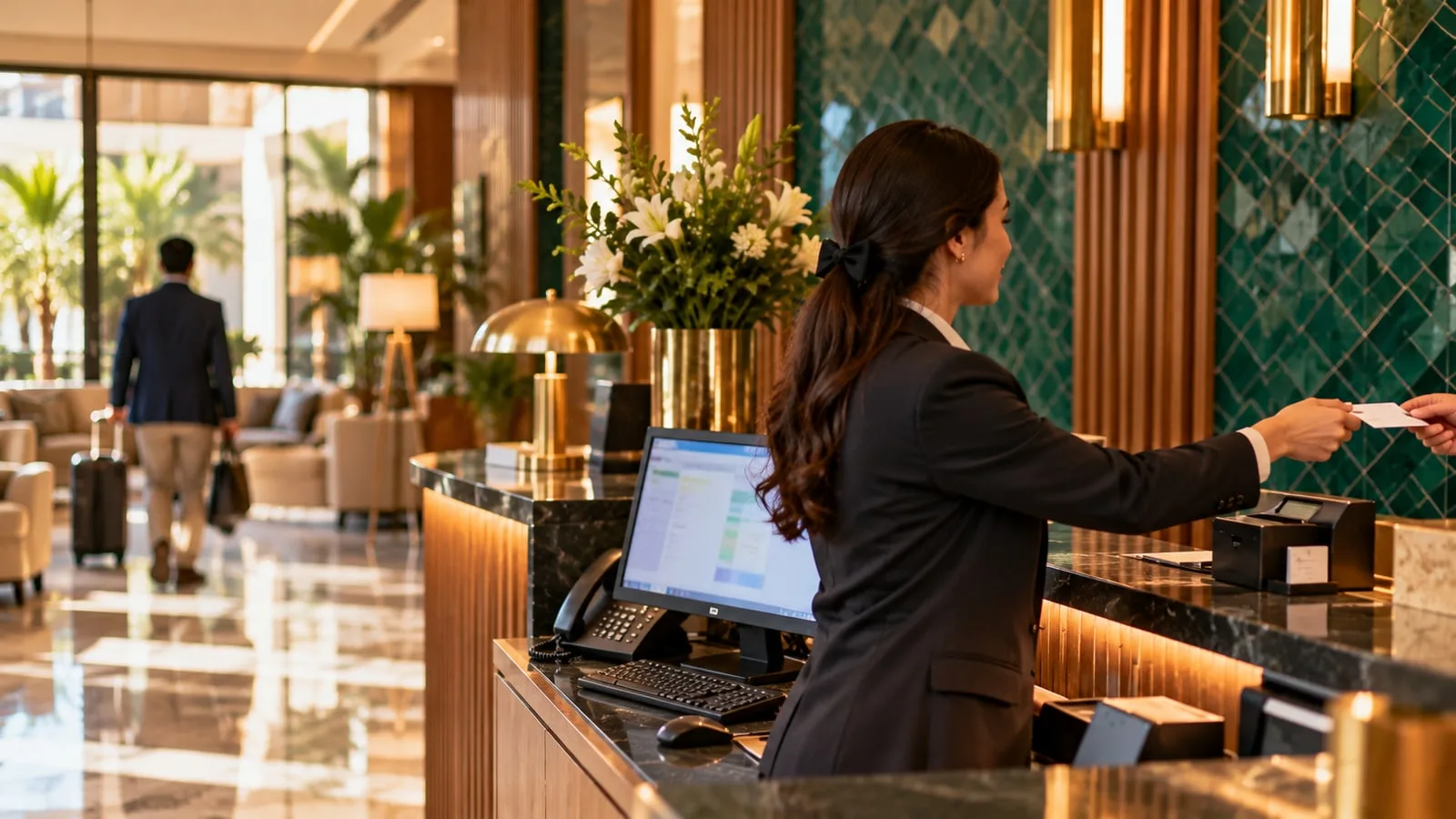

Hotel phone system in Morocco: rooms, PMS, wake-up calls and call billing
Hotel phone system in Morocco: room phones, wake-up calls, call billing and PMS integration (FIAS) with 3CX, Yeastar or Grandstream UCM, based on vendor docs.
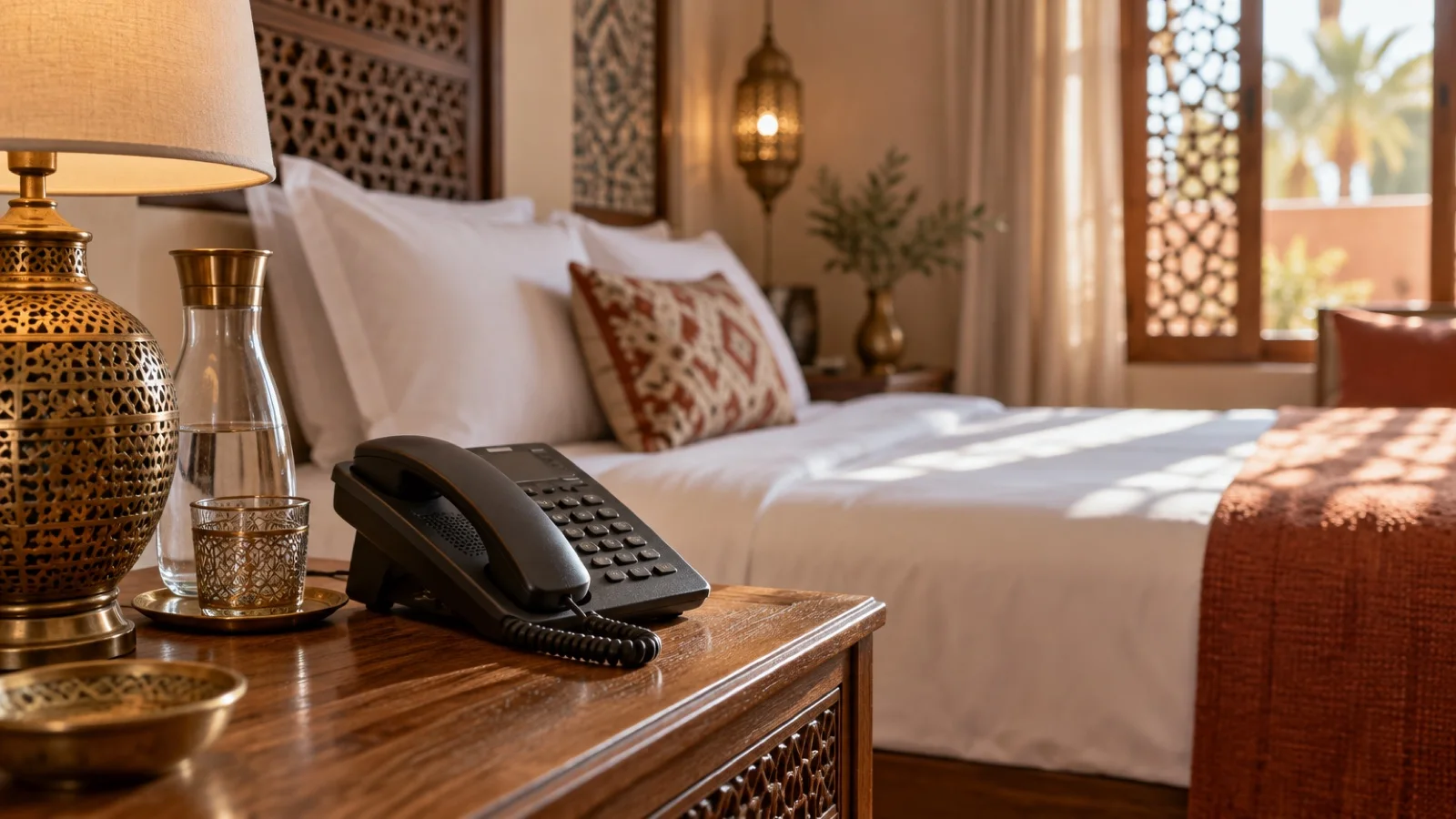
The short answer: in a hotel, the phone system is more than a front-desk tool. It must talk to the property management system (PMS) to open and close room calling rights, display the guest’s name, schedule wake-up calls, track housekeeping and post calls to the bill. 3CX, Yeastar and Grandstream can all do this, usually through the FIAS protocol, but under different conditions: model, edition, paid module, accepted protocol. This guide relies only on what the vendors document.
For the general choice between these three solutions, see our guide to business IP phone systems in Morocco. Here we focus on what is specific to hotels.
What a hotel phone system must do
| Function | What it brings |
|---|---|
| Check-in and check-out | Room calling rights opened at check-in, closed at check-out, call log cleared |
| Guest name | Reception sees who is calling; the phone can greet the guest by name |
| Wake-up calls | Scheduled by reception or by the guest from the room |
| Room status | Housekeeping reports “clean”, “dirty”, “inspected” from the room phone |
| Do not disturb | Enabled from the room or by reception |
| Call billing | Outbound calls rated and posted to the guest bill |
| Minibar | Consumption entered from the room phone, depending on the system |
| Service keys | Reception, room service, concierge, with one press |
A security point from the outset: by default, a vacant room should only call reception and emergency numbers. An occupied room gets outside calls only if the hotel decides so. This is the first protection against toll fraud.
The PMS and the FIAS protocol
The PMS (Property Management System) is the software that manages bookings, rooms and billing. To exchange data with the phone system, many PMS products use FIAS (Fidelio Interface Application Specification), Oracle Hospitality’s interface protocol, which comes from Micros Fidelio. Others use the Mitel protocol or go through middleware.
So the question to ask your PMS vendor is simple: which telephony interface do you offer, using which protocol, and does it need an interface licence on your side? The answer shapes the choice of phone system. Ask also whether the interface runs on the PMS server or on a separate machine, and who supports it when the link drops: the PMS vendor, the phone system integrator, or both.
3CX: the hotel module and its two protocols
According to 3CX documentation, the hotel module integrates with PMS products in two ways:
- The Fidelio protocol (FIAS), for Micros Fidelio and Protel. 3CX states that FIAS is supported by Fidelio Suite 6, 7 and 8 and OPERA, but not by Fidelio Xpress. In this mode, 3CX sends the PMS the calls made from the room (time, destination and cost based on the rates configured in 3CX); the PMS can use that cost or recalculate it.
- The Mitel SX2000 protocol, for Mitel-compatible software. 3CX notes that this protocol has no call billing interface.
In both cases, the PMS must be reachable on the phone system’s local network, and the integration is set in the admin console, under hotel services. Without a PMS, reception can assign a room to a guest and clear it from the 3CX Web Client; the documentation notes that no billing receipt is then generated at check-out.
3CX suits a hotel that uses a FIAS PMS and also wants 3CX’s strengths: mobile apps for staff, a contact centre for reservations, WhatsApp and web chat. As a 3CX partner in Morocco, we check compatibility with your PMS before any proposal.
Yeastar P-Series: built-in hotel module or FIAS integration
Yeastar offers two approaches, documented in its help centre:
- The hotel management module, built into the phone system as an add-on subscription with a trial period. Reception uses Linkus (desktop or web app) to handle check-ins, check-outs and room moves, wake-up calls, room status and do not disturb. Guests can set their wake-up call from the room phone. Outbound calls are rated with call rate rules and posted to the bill. By default, rooms can only call service and emergency numbers.
- PMS integration over FIAS, tested by Yeastar with Oracle Hospitality OPERA and, according to Yeastar, applicable to FIAS-compatible PMS products. Depending on what the PMS supports: guest name assigned to the extension at check-in, wake-up calls scheduled from the PMS, call and minibar charges posted to the bill, do-not-disturb sync. On the Appliance edition, Yeastar states that this integration is limited to the P550, P560 and P570; the Software edition requires the PMS integration add-on.
For PMS products that do not support FIAS, Yeastar points to its open API for custom integration. Model choice is covered in which Yeastar P-Series to choose.
Grandstream UCM: built-in PMS, FIAS and middleware
Grandstream is the most hotel-oriented vendor of the three:
- The local PMS built into the UCM6300 manages rooms, check-ins, wake-up calls (including recurring ones), the minibar and housekeeping, with no external hotel software.
- Oracle OPERA integration over FIAS, through Oracle’s interface dedicated to Grandstream UCMs. Grandstream’s documentation lists check-in and check-out, room moves, wake-up calls, housekeeping status, do not disturb, per-room calling rights, minibar and external call billing, plus the guest name shown on auto-provisioned phones. It covers the UCM6300 and UCM6300 Audio series and CloudUCM, with a minimum firmware version.
- Other integrations: Grandstream cites HMobile, HSC, Mitel and IDS, plus an open PMS API for integrators.
Grandstream also states that the room’s call history can be cleared automatically at check-out, a useful privacy feature. UCM capacities are covered in which Grandstream UCM to choose.
Comparing the three approaches
| Criterion | 3CX | Yeastar P-Series | Grandstream UCM |
|---|---|---|---|
| Hotel functions without a PMS | Check-in and check-out from the Web Client | Full hotel module (subscription) | Built-in local PMS |
| FIAS integration | Yes (Fidelio, Protel, OPERA) | Yes (OPERA, Fidelio), P550 to P570 or Software edition | Yes (Oracle OPERA) |
| Other protocols | Mitel SX2000 | Open API | HMobile, HSC, Mitel, IDS, API |
| Call billing | Via FIAS | Hotel module or FIAS | Via OPERA or direct billing |
| Room phones | Compatible SIP phones | Compatible SIP phones | Dedicated GHP series, auto-provisioned |
Our honest view: Grandstream covers the most hotel functions natively, with dedicated room phones. Yeastar offers a complete hotel module and simple day-to-day management. 3CX is mostly justified when the hotel also wants a real contact centre for reservations. In every case, compatibility with your PMS is confirmed before purchase.
Phones: rooms, reception, mobile staff
- Rooms: discreet phones with service keys. Grandstream’s GHP series comes in WiFi versions, which avoids pulling a cable into a renovated room.
- Reception: phones with many busy-lamp keys, a headset, and a view of room status.
- Mobile staff (housekeeping, room service, maintenance, security): DECT handsets, or WiFi phones such as Grandstream’s WP series, if the WiFi is designed for voice.
- Common areas: courtesy phones in the lobby, limited to internal calls.
A hotel network: separate, prioritise, cover
Hotel telephony often shares the building with heavily used guest WiFi. Put voice in a dedicated VLAN with priority, and fully isolate the guest network. For WiFi phones, coverage must be designed for voice in corridors, kitchens and basements; see high-density enterprise WiFi. Plan a UPS for the phone system and switches, and a backup for the internet link or SIP trunk.
Guest data and recording
Guest names, numbers called from rooms, wake-up times: these are personal data covered by law 09-08. Restrict access, set retention periods and delete stay-related data according to your rules. Never record room calls; if the reservations desk records its calls, the conditions are covered in call recording for businesses.
Mistakes we fix in hotels
- Vacant rooms open to international calls, an ideal fraud target.
- A PMS bought without a telephony interface, discovered at integration time.
- Wake-up calls scheduled by hand on paper, for lack of integration.
- Guest WiFi and voice on the same network, hence poor audio in the evening.
- Call logs never cleared between guests.
How a successful PMS integration unfolds
- Inventory: number of rooms and phones, PMS used, its version, and the telephony interface it offers.
- Validation with the PMS vendor: protocol, interface licence, network settings, and who configures what on each side.
- Numbering plan: extension number equal to room number, short service numbers, calling rights per room category.
- Configuration and tests: check-in, room move, check-out, wake-up, do not disturb, billed call, minibar where relevant. Each function is tested on a pilot room before rollout.
- Training for reception, housekeeping and maintenance, each on what they actually use.
- Follow-up in the first weeks: a PMS link that drops without an alert means missed wake-up calls and unbilled calls. It must be monitored like everything else.
Checklist before choosing
- PMS identified, with its telephony interface and licence.
- Expected functions listed: wake-up, billing, housekeeping, minibar, guest name.
- Calling rights defined for vacant and occupied rooms.
- Phones chosen: rooms, reception, mobile staff, common areas.
- Voice network separated from guest WiFi, DECT or WiFi coverage checked.
- Retention rules for guest data set.
How we work
We start with a free audit of your telephony: rooms, phones, lines, network, and above all your PMS and its telephony interface. We then recommend the best fit among 3CX, Yeastar and Grandstream, confirm compatibility with the PMS vendor, and install and configure the phone system, handsets and integration. After opening, the system is monitored 24/7 and a critical incident is handled in under 15 minutes.
Explore our IP telephony in Morocco offering and our hospitality and restaurants page, then request your free telephony audit: we reply within 24 business hours.
Frequently asked questions
What is PMS integration for a hotel phone system?
It is the link between the phone system and the hotel management software. When a guest checks in, the PMS opens the room’s calling rights and can display the guest’s name; at check-out, it closes them. The phone system sends calls made from the room back to the PMS so they are added to the bill.
Is my PMS compatible with 3CX, Yeastar or Grandstream?
If your PMS supports the FIAS protocol (Oracle OPERA, Micros Fidelio and others), all three systems support it, each with its own conditions. 3CX also accepts the Mitel SX2000 protocol, and Grandstream works with middleware such as HMobile, HSC, Mitel or IDS. Always confirm the exact interface and its licence with the PMS vendor.
Can guest wake-up calls be managed without a PMS?
Yes. Yeastar’s hotel module and the local PMS built into Grandstream UCMs let reception schedule wake-up calls, and guests can set them from the room phone. With 3CX, reception handles check-in and check-out from the Web Client; advanced functions go through the PMS.
How are room calls billed?
With a FIAS PMS, the phone system sends each outbound room call to the PMS, which adds it to the bill. Without a PMS, Yeastar’s hotel module rates calls using call rate rules and posts them to the guest bill. Rates are always set by the hotel.
Do rooms need special phones?
Not necessarily, but hotel phones are designed for the job: preset service keys (reception, room service, wake-up), a discreet design, and WiFi versions to avoid cabling. Grandstream offers a dedicated range, the GHP series.
About the editorial team
ALLSAFE SOLUTIONS
Network, security and cloud engineers
Written by the engineering team at ALLSAFE SOLUTIONS, a managed IT provider founded in Casablanca by network, security and cloud engineers. Our articles draw on the projects we deliver for clients in Morocco and abroad.
LinkedIn