



































Yeastar P-Series in Morocco: which model (P520, P550, P560, P570) and which edition to choose
Yeastar P520, P550, P560 or P570 in Morocco: users, concurrent calls, FXO/FXS/4G ports, Appliance, Software and Cloud editions, and feature plans.

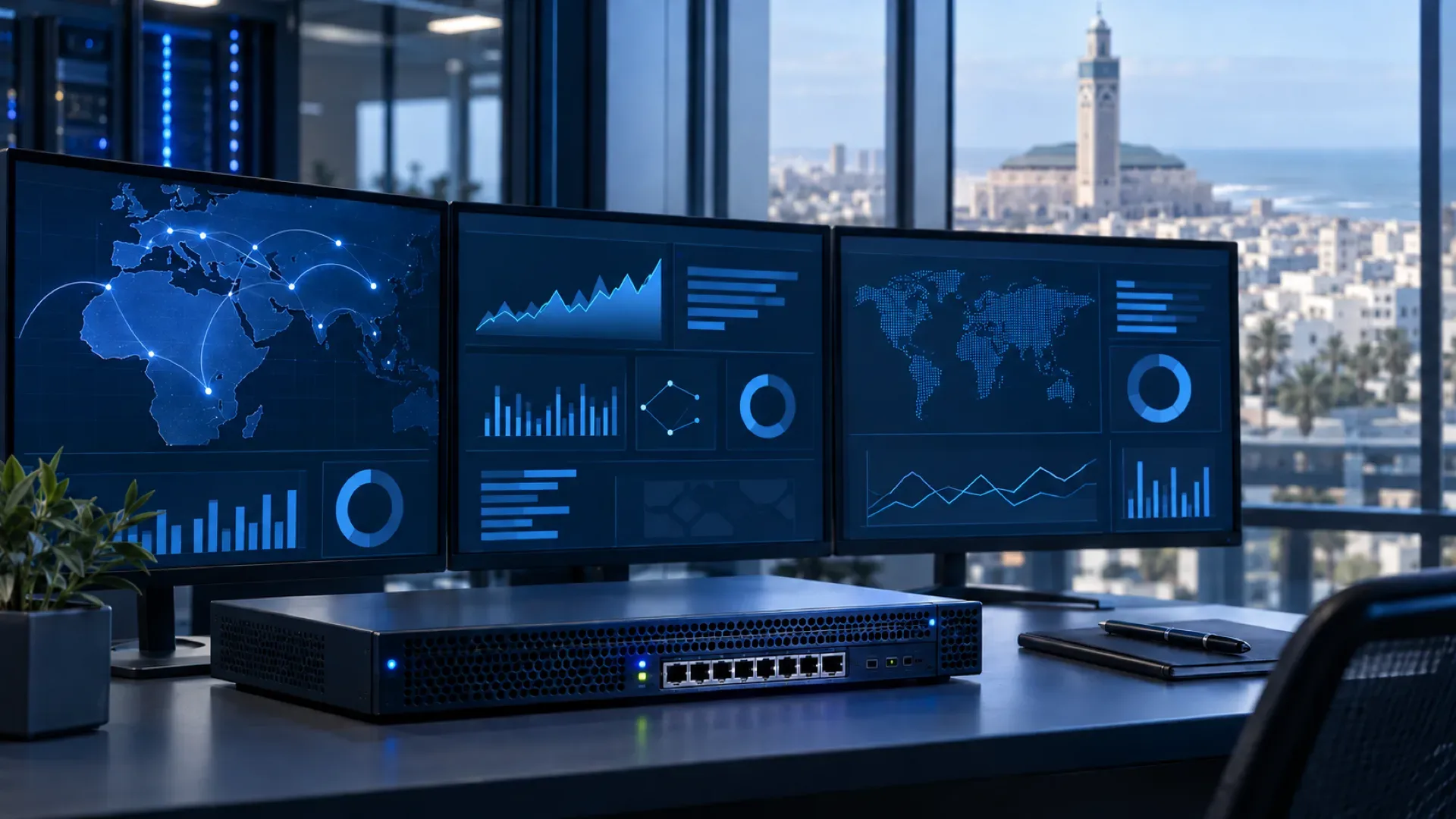
The short answer: you choose a Yeastar P-Series on two vendor-published figures, the number of users and the number of concurrent calls, then on the ports you need to keep your analogue lines, and finally on the feature plan. The P520 covers a small organisation of 20 users, the P550 an SMB of up to 50, the P560 a company of 100 to 200, and the P570 a head office of 300 to 500. The plan decides whether you get a call centre, CRM integrations or video conferencing. As a Yeastar certified partner in Casablanca, here is our selection grid, the available editions and the mistakes we see on quotes.
The four P-Series models, vendor figures
For each appliance, Yeastar publishes a base capacity and a maximum capacity after expansion. These are the values shown on the official Appliance Edition page.
| Model | Users (base / max) | Concurrent calls (base / max) | Max FXS | Max FXO/BRI | Max 3G/4G | Max E1/T1 |
|---|---|---|---|---|---|---|
| P520 | 20 | 10 | 4 | 4 | 1 | – |
| P550 | 50 | 25 | 8 | 8 | 4 | – |
| P560 | 100 / 200 | 30 / 60 | 8 | 8 | 4 | 1 |
| P570 | 300 / 500 | 60 / 120 | 16 | 16 | 6 | 2 |
Three things to remember. The P520 and P550 have a fixed capacity: go beyond 50 users and you need a new box. The P560 and P570 expand with DSP modules: each module adds 100 users and 30 concurrent calls, with at most one module on the P560 and two on the P570. Finally, Yeastar states that the P520 supports neither the APIs nor hotel PMS integration, and that its availability depends on each region’s sales policy: we check it before proposing it.
Which model for which company profile
The capacities above are ceilings. The right model covers your users and your peak-hour concurrent calls, with headroom for the growth expected over the life of the box.
| Profile | Model we look at first | Why |
|---|---|---|
| Professional firm, branch, small shop, up to 20 extensions | P520 | Compact; a few analogue lines or a 4G backup are enough |
| SMB of 20 to 50 extensions, reception and a few queues | P550 | Up to 8 FXO/BRI ports and 4 3G/4G ports |
| Company of 50 to 200 extensions, clinic, school | P560 | Expandable with a DSP module, one E1 port possible |
| Multi-department head office, hotel, industrial site up to 500 extensions | P570 | Up to 16 FXO/BRI, 16 FXS and 2 E1, two expansion boards |
Concurrent calls are often the real criterion. A 30-person contact centre can saturate the 25 calls of a P550, while a 45-person administrative office will never come close. To estimate it, we start from real data: logs from the old PBX, carrier statements, number of busy lines at the daily peaks.
Keeping analogue lines: modules and expansion boards
This is Yeastar’s historical advantage over a purely software phone system: the appliance connects existing lines and equipment directly through plug-in modules.
- O2: 2 FXO ports to connect 2 analogue carrier lines.
- S2: 2 FXS ports for 2 analogue phones, a fax or a door station.
- SO: 1 FXS and 1 FXO, handy for analogue-line fallback.
- B2: 2 BRI ports (ISDN basic rate).
- 3G module: 1 channel for voice calls over a SIM card; the 4G LTE module provides cellular data.
To go beyond the built-in slots, the P560 accepts one expansion board and the P570 two. The EX08 board has 4 module slots and 8 interfaces on the panel; the EX30 has one E1/T1/PRI port. In practice, a clinic that keeps its reception analogue lines, a few analogue phones in patient rooms and a fax connects without any external gateway.
If your lines are to move to a SIP trunk later, plan the transition from the start, as we explain in SIP trunk: keeping your business numbers. The appliance can run both side by side during the migration.
Appliance, Software or Cloud: the three editions
The same P-Series software comes in three forms.
| Edition | Where it runs | For whom |
|---|---|---|
| Appliance | P520 to P570 box on your premises | Sites with analogue lines, desk phones, a need to work on site |
| Software | Your server or cloud: VMware, Hyper-V, KVM, Proxmox, or public cloud providers | Companies with existing virtualised infrastructure; Yeastar states up to 10,000 users and 1,000 concurrent calls |
| Cloud | Hosted by Yeastar, or on your own infrastructure | Distributed teams, remote work, no telephony hardware to maintain |
Two nuances weigh on the choice. AI features such as the AI Receptionist and call transcription are only offered on the Software and Cloud editions, with an additional per-minute subscription. Conversely, direct connection of analogue lines exists only on the appliance. High availability (Hot Standby) is possible on the appliance and the software, with a second redundancy server.
Feature plans: Basic, Standard, Enterprise, Ultimate
The appliance ships with a free Basic Plan covering basic telephony. Advanced features are enabled by subscription, annual or monthly.
| Plan | Editions | What it adds |
|---|---|---|
| Standard | Appliance only | Full telephony (IVR, queues, recording, forwarding), Linkus apps, operator panel, team chat, secure remote access |
| Enterprise | Appliance, Software, Cloud | Plus: inbound call centre (wallboard, queue panel, callback), omnichannel messaging (WhatsApp, SMS, web chat, Facebook), CRM, helpdesk and Microsoft 365 integrations, remote SIP registration, remote archiving |
| Ultimate | Appliance, Software, Cloud | Plus: video calls and conferencing, Call Flow Designer, Message Flow Designer, Active Directory integration, Linkus SDK |
For a professional firm or an SMB that wants a reliable phone system and mobile apps, the Standard Plan is often enough. As soon as a reception desk runs supervised queues, or calls must flow into a CRM such as Odoo, HubSpot or Zoho, aim for Enterprise. We cover reception design in queues, IVR and statistics. Note that the Cloud Edition hosted by Yeastar requires at least an Enterprise Plan, and remote archiving there requires the Ultimate Plan.
Linkus: the extension that follows your staff
Linkus is Yeastar’s unified communications app, available as a web client, a Windows and macOS desktop app, an iOS and Android mobile app, and a Google Chrome extension. It gives each user their extension, voicemail, team chat and call history, and lets them flip a call from one device to another. On the appliance, remote access goes through Yeastar’s Remote Access Service, which avoids exposing the PBX to the internet through port forwarding.
The mistakes we fix most often
- Choosing on headcount without counting peak-hour concurrent calls.
- Buying a P550 for a growing company: its capacity does not expand, so the box will have to be replaced.
- Forgetting analogue equipment: fax, door station, alarm or lift connected to a line, discovered on cut-over day.
- Buying the box without the right plan: a reception desk with supervised queues or a CRM integration does not work with the Standard Plan alone.
- Expecting AI on the appliance: the AI Receptionist and call transcription belong to the Software and Cloud editions.
- Neglecting the network: PoE switches, voice VLAN and quality of service make call quality, see the 10 mistakes that ruin call quality.
Checklist before ordering
- Number of users today and expected over the life of the box.
- Peak-hour concurrent calls, measured on the existing system.
- Analogue, BRI or E1 lines to keep, and the timeline for moving to a SIP trunk.
- Analogue equipment inventoried: phones, fax, door stations, alarms.
- Need for a 3G/4G backup.
- Edition chosen: Appliance, Software or Cloud.
- Plan chosen by usage: telephony, call centre, CRM, video.
- Remote workers and sales staff equipped with Linkus.
- Network checked: PoE, voice VLAN, firewall, internet link.
How we do it
We start with an audit of what exists: lines, numbers, handsets, connected equipment, call logs and network. We then compare editions and plans on your real case, and if 3CX or another solution fits better, we say so, as in our 3CX, Yeastar or Teams Phone comparison. Next come a pilot with a few users, the configuration (IVR, queues, ring groups, recording, Linkus), a staged migration with rollback, then 24/7 monitoring of the phone system within our IP telephony offering. For the big picture, read our business IP phone system guide for Morocco, and see our projects in our case studies.
Torn between two models or two plans? The initial audit is free: contact us and we will reply within 24 business hours with a model, edition and plan recommendation based on your real usage.
Frequently asked questions
What is the difference between the Yeastar P520, P550, P560 and P570?
Capacity. According to Yeastar, the P520 handles 20 users and 10 concurrent calls, the P550 50 users and 25 calls, the P560 100 users and 30 calls expandable to 200 and 60, and the P570 300 users and 60 calls expandable to 500 and 120. The maximum number of analogue, BRI, 4G and E1 ports also grows from one model to the next.
Can you keep analogue lines with a Yeastar P-Series?
Yes. O2 modules (2 FXO ports) or SO modules (1 FXS and 1 FXO) connect the carrier's analogue lines, and S2 modules (2 FXS) keep analogue phones, fax machines or door stations. The P520 accepts up to 4 FXO/BRI ports, the P570 up to 16.
Which Yeastar plan should you choose: Standard, Enterprise or Ultimate?
The Standard Plan covers telephony, the Linkus apps and remote access. Enterprise adds the inbound call centre, omnichannel messaging, CRM and Microsoft 365 integrations. Ultimate adds video conferencing, Call Flow Designer and Active Directory integration. A free Basic Plan covers basic telephony.
Yeastar appliance, software or cloud: which one?
The appliance suits sites that keep analogue lines and desk phones and want a phone system that works on premises. The Software Edition runs on your own server or cloud (VMware, Hyper-V, KVM, Proxmox). The Cloud Edition removes all on-site telephony hardware but requires an Enterprise or Ultimate Plan.
About the editorial team
ALLSAFE SOLUTIONS
Network, security and cloud engineers
Written by the engineering team at ALLSAFE SOLUTIONS, a managed IT provider founded in Casablanca by network, security and cloud engineers. Our articles draw on the projects we deliver for clients in Morocco and abroad.
LinkedIn