



























GSM / 4G gateway for an IP phone system in Morocco: OpenVox, Dinstar or Yeastar TG?
GSM or 4G VoIP gateway in Morocco: use cases, SIM count, VoLTE, SMS, integration with 3CX, Yeastar and Grandstream, and what to check with the carrier.
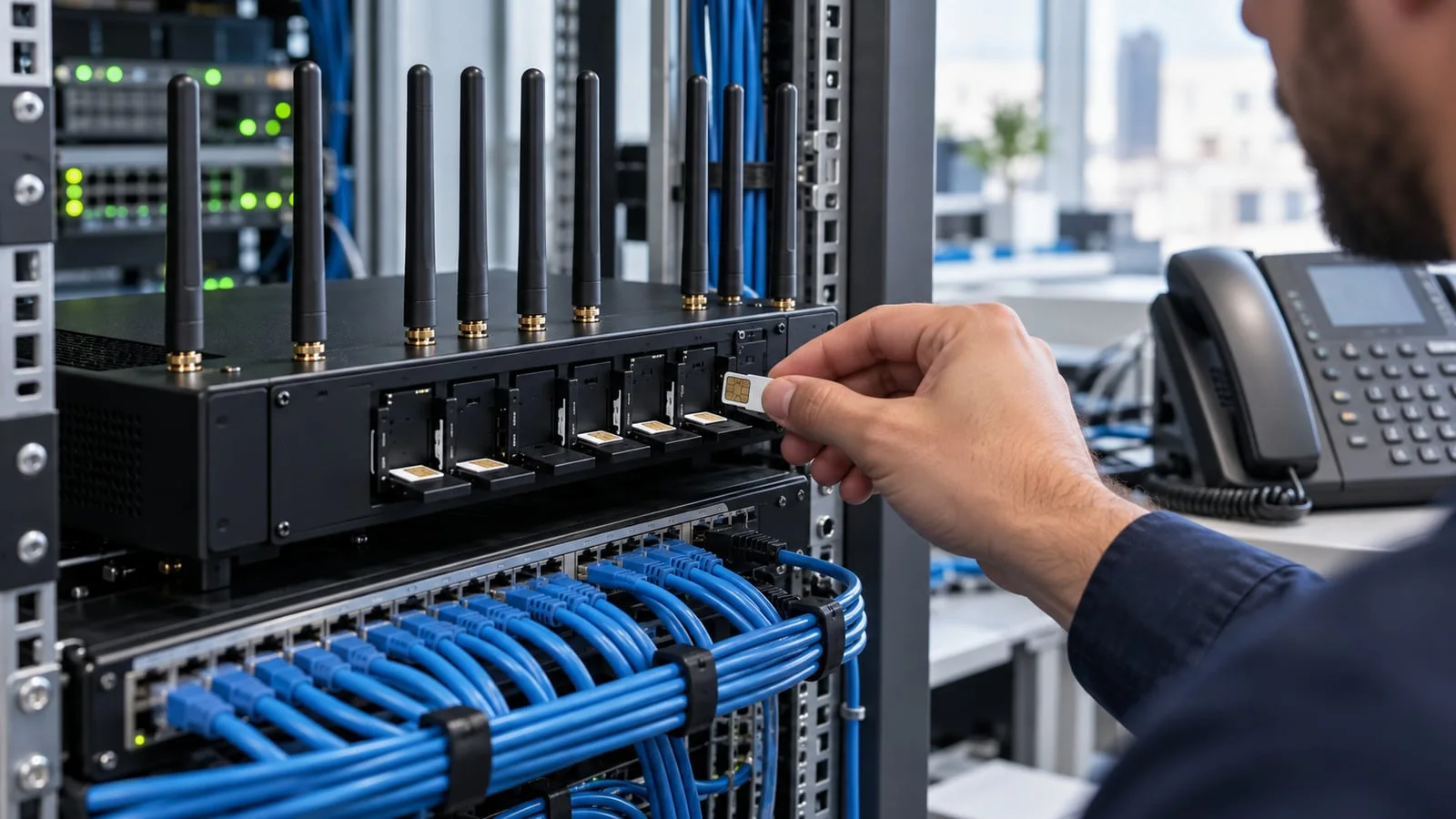
The short answer: a GSM or 4G gateway is a box that holds SIM cards and presents them to your IP phone system as a SIP trunk. Each SIM card equals one concurrent call. It does three jobs: sending calls to mobiles over the mobile network, keeping a backup path when the SIP trunk or fixed line is down, and sending or receiving SMS from your applications. Before comparing OpenVox, Dinstar and Yeastar TG, three things matter more than the brand: VoLTE-capable 4G channels, SIM cards whose gateway use is approved by the carrier, and a well-placed antenna.
At ALLSAFE SOLUTIONS, we install and integrate OpenVox, Dinstar and Yeastar TG gateways in Casablanca and across Morocco, on 3CX, Yeastar and Grandstream phone systems. We are an official 3CX partner, a Yeastar certified partner and a Grandstream integrator. We supply hardware and licences to businesses, with or without installation, without being a distributor. Every capacity quoted here comes from datasheets published by the vendors; we do not give prices, which vary by supplier and over time.
What a GSM / 4G gateway does on an IP phone system
A GSM gateway (or 4G VoIP gateway) sits between the phone system and the mobile network: the system sends it a call over SIP, it passes the call on through one of its SIM cards, and the other way round. We see it used in four situations.
- Outbound calls to mobiles. Customers, couriers, technicians: routing these calls through fleet-plan SIM cards can be better value than going through the landline, depending on your plan. The comparison is made on your own bills, not on a general rule.
- Backup when the SIP trunk or fixed line fails. The phone system automatically switches outbound calls to the gateway and extensions keep calling. This is the use we recommend most often, alongside what we cover in SIP trunk: keep your business numbers.
- Sites without a fixed line. Building site, warehouse, branch awaiting connection: the gateway delivers full business telephony until fibre arrives.
- SMS from your business systems: appointment reminders, monitoring alerts, field service notifications.
What it does not do: replace your reception landline number (an outbound call shows the SIM card’s mobile number), or make up for poor mobile coverage in your premises.
How many channels and SIM cards to plan for
The rule is simple: one channel equals one concurrent call, and each channel needs an active SIM card. A 4-channel gateway handles 4 calls at once, not one more. Sizing depends on the intended use:
- Backup only: the number of outbound calls you want to guarantee during an outage, usually reception and critical functions, not the whole company.
- Main route to mobiles: the number of concurrent calls to mobiles at peak times, measured from your current phone system’s call logs.
- Outbound call centre: the number of agents calling at the same time, within the limits set by carriers, see call centre with 3CX in Morocco.
Spread SIM cards across several carriers: if one network is disrupted, the other channels keep working.
OpenVox, Dinstar and Yeastar TG: the current ranges
All three vendors offer standalone gateways that connect over SIP to any IP phone system. The table below lists the capacities published in their datasheets.
| Range | Models | Mobile channels | Networks | Notable points (vendor datasheets) |
|---|---|---|---|---|
| Yeastar TG | TG200, TG400, TG800, TG1600 | 2, 4, 8 or 16 4G channels | 4G LTE (bands depend on module) | VoLTE if the carrier supports it, SMS and bulk SMS, USSD, open API for SMS/USSD, SIP and IAX2, 4-in-1 antenna splitter on TG400, TG800, TG1600 |
| Dinstar UC2000-VE | VE-4, VE-8 | 4 or 8 channels | GSM or LTE depending on version | LTE versions advertised with VoLTE |
| Dinstar UC2000-VF | VF-8, VF-16 | 8 or 16 channels | GSM or LTE depending on version | LTE versions advertised with VoLTE, antenna combiner on some GSM versions |
| Dinstar UC2000-VG | VG-32 | 32 channels, 32 SIM slots | LTE-FDD, LTE-TDD, WCDMA, GSM | VoLTE, hot-swappable SIMs, LCD display, HTTP API for SMS, SMS to email and email to SMS |
| OpenVox VoxStack | VS-GWP1600 (1U), VS-GWP2120 (2U) | 4 to 20 channels (5 modules) or 4 to 44 channels (11 modules) | GSM, WCDMA or LTE depending on module | Hot-swappable modules and SIMs, SMS, USSD, SMPP, SMS API, stated compatibility with Asterisk, 3CX and FreeSWITCH |
Sources: Yeastar TG Series, Dinstar UC2000 and OpenVox GWP datasheets. The older single-channel GSM or 3G TG100 no longer appears on the current datasheet, and OpenVox lists its SWG and VS-GW1600 series as end of life: avoid them for a new project.
In short: Yeastar TG covers 2 to 16 channels well, with an interface close to Yeastar phone systems. Dinstar goes up to 32 channels with the VG series and rich SMS features. OpenVox VoxStack is modular: you add 4-channel modules in the same chassis.
VoLTE, 2G, 3G: the point that decides equipment lifetime
This is the question most often missing from quotes. Several carriers around the world have already switched off their 2G or 3G networks to reallocate spectrum to 4G and 5G. At the time of writing, we are not aware of a public shutdown schedule in Morocco, but installing a gateway in 2026 whose voice relies only on 2G or 3G would be unwise.
Three checks to make:
- 4G LTE channels, not just GSM. With Dinstar and OpenVox, the technology depends on the version or module ordered; the exact part number matters.
- Voice over VoLTE. A 4G module can carry data over LTE but fall back to 3G or 2G for voice if VoLTE is not active. Yeastar says so plainly on its datasheet: VoLTE “if the carrier supports”. The carrier must therefore enable VoLTE on the SIM card and accept the equipment.
- The module’s frequency bands, compared with those your carrier uses in Morocco. Vendors offer modules per region; a module intended for another continent may not register on the local network.
We always test a VoLTE call with each selected carrier before going live.
SMS: what gateways can do
All the ranges above send and receive SMS. Depending on the model, the datasheets list bulk SMS, SMS to email, an HTTP API and, at OpenVox, the SMPP protocol: an ERP or monitoring tool can send an SMS with a simple request.
Two precautions: have the carrier approve your expected SMS volume, and remember that a marketing SMS is still processing of personal data, subject to recipients’ consent, as we explain in our article on Morocco’s data protection law 09-08.
Integration with 3CX, Yeastar P-Series and Grandstream UCM
On the phone system side, the gateway is a SIP trunk; the work happens in the routing rules.
- 3CX: the gateway is added as a SIP trunk or gateway, then outbound rules send the chosen prefixes to it, for example mobile numbers starting with 06 and 07, or use it as a fallback route behind the main trunk. OpenVox explicitly states 3CX compatibility. See our 3CX IP telephony offer.
- Yeastar P-Series: two options. Either an external TG gateway connected as a SIP trunk, or GSM / 3G / 4G LTE modules fitted directly in the appliance: Yeastar’s datasheet lists up to 1 cellular channel on the P520, 4 on the P550 and P560, and 6 on the P570. Beyond that, or to keep the mobile side separate, an external gateway is the way to go. Details in Yeastar P-Series: which model to choose.
- Grandstream UCM: UCMs have no built-in mobile interface; the gateway connects as a VoIP trunk, then outbound routes and failover are set in the UCM. See Grandstream UCM: which IP PBX to choose.
We also configure the inbound direction, so that a call received on a SIM card reaches the right queue, and we secure the gateway like the phone system: strong password, administration not exposed to the internet, international calls blocked by default.
What to check with the carrier
This is where most bad surprises happen. Here are the questions to ask your carrier, in writing, before buying:
- Do the plan’s terms and conditions allow SIM cards to be used in a gateway or fixed equipment? Some consumer plans exclude it.
- Is a business or fleet plan available, with lines registered to the company?
- Can VoLTE be enabled on these lines, and is the equipment accepted?
- Do usage caps apply (call duration, number of SMS, number of recipients)?
A matter of principle: a gateway is for your own business calls. Traffic diversion, in particular terminating international calls on local SIM cards, is fraud that carriers detect and punish by cutting the lines. We do not take on that kind of project.
Antenna, placement and call quality
Call quality through a gateway depends first on the radio signal. A gateway locked inside a metal rack in a basement will produce poor calls. Our method:
- Measure the signal of each carrier at the planned location, with the gateway itself (web interfaces show the level per channel), not with a phone.
- Move the antennas to a well-covered spot, near a window or on the façade, with good-quality cable of reasonable length.
- Use an antenna splitter on models that offer one (Yeastar TG400, TG800 and TG1600, some Dinstar versions) to avoid a forest of antennas.
- Test real calls on every channel, in both directions, before going live.
On the network side, treat the gateway as voice equipment: voice VLAN, QoS, no SIP ALG on the router. Other causes of poor quality are covered in the mistakes that ruin call quality.
How to choose: our grid
| Situation | Our recommendation |
|---|---|
| Backup for a Yeastar P-Series system, a few calls to guarantee | 4G modules in the appliance, or Yeastar TG200 / TG400 |
| Backup for a 3CX or Grandstream system, up to 16 calls | Yeastar TG or Dinstar UC2000-VE / VF in LTE version |
| Heavy outbound call flow to mobiles | Dinstar UC2000-VG 32 channels or OpenVox VS-GWP2120 |
| Growing needs, gradual scale-up | OpenVox VoxStack, adding 4-channel modules |
| Sending SMS from an ERP or application | Model with HTTP API or SMPP, depending on the tool to connect |
| Analogue or E1 lines to keep | Not a GSM gateway: see FXO, FXS and E1 gateways |
Mistakes we fix
- A GSM-only gateway, with no 4G, bought on price: it depends on a network that is on its way out.
- Consumer-plan SIM cards, cut off by the carrier once gateway use is detected.
- All SIMs with the same carrier: one network outage takes out the whole backup.
- No inbound routing: customers calling back the mobile numbers reach nobody.
- The gateway’s web interface open to the internet, with the default password: a gateway to toll fraud.
- Failover never tested before the day of the outage.
Checklist before ordering
- Intended use: backup, main route to mobiles, site without a landline, SMS.
- Number of concurrent calls to guarantee, hence channels and SIM cards.
- Selected carriers, business plan approved in writing, VoLTE enabled.
- Module frequency bands compatible with Moroccan networks.
- Existing phone system (3CX, Yeastar, Grandstream) and desired routing rules.
- Gateway location, signal measurement, antenna cable length.
How we work
We start with a free audit of your usage, your call logs and the mobile coverage on site. We then size the gateway, prepare the routing rules, and install and test each channel with your carriers. Once in service, the gateway, its channels and failover are monitored 24/7, and a critical incident is handled in under 15 minutes.
To place the gateway within your overall telephony, read our guide to business IP phone systems in Morocco and explore our IP telephony offer. Then request your free initial audit: we reply within 24 business hours with a recommendation tailored to your lines and carriers.
Frequently asked questions
How many concurrent calls can a GSM or 4G gateway handle?
As many as it has channels fitted with an active SIM card: one channel equals one call at a time. According to the vendors’ datasheets, Yeastar TG ranges from 2 to 16 4G channels, Dinstar UC2000 from 4 (VE series) to 32 channels (VG series), and OpenVox VS-GWP1600 from 4 to 20 channels in modules of 4.
Does a 4G gateway work with 3CX, Yeastar and Grandstream?
Yes. The gateway is set up as a SIP trunk on the phone system, whether 3CX, a Yeastar P-Series or a Grandstream UCM. The system’s routing rules then decide which calls go out through the SIM cards, for example calls to mobiles, or all calls when the main trunk is down.
Can any SIM card be used in a GSM gateway in Morocco?
Technically yes, if the frequency bands match, but the terms of some plans exclude gateway use. We recommend lines registered to the company, on a business or fleet plan, with the carrier’s written approval of the intended use.
Should I choose a 2G, 3G or 4G gateway?
4G, for the lifetime of the equipment: several carriers around the world have already switched off their 2G or 3G networks. Also check that voice runs over VoLTE with your carrier and SIM card; Yeastar, for example, states that VoLTE on its TG gateways depends on carrier support.
Will people we call see our landline number?
Generally not: an outbound call through a SIM card presents that card’s mobile number. If showing the landline number is essential, calls must go out through the SIP trunk or the fixed line, and the gateway stays a backup or a dedicated route to mobiles.
About the editorial team
ALLSAFE SOLUTIONS
Network, security and cloud engineers
Written by the engineering team at ALLSAFE SOLUTIONS, a managed IT provider founded in Casablanca by network, security and cloud engineers. Our articles draw on the projects we deliver for clients in Morocco and abroad.
LinkedIn