Hosting your servers and backups in a datacenter in Morocco: colocation, cloud or second site?
Datacenter in Morocco: colocation, cloud or second site for your servers and backups. Tier, connectivity, power, access, reversibility, SLA, law 09-08.

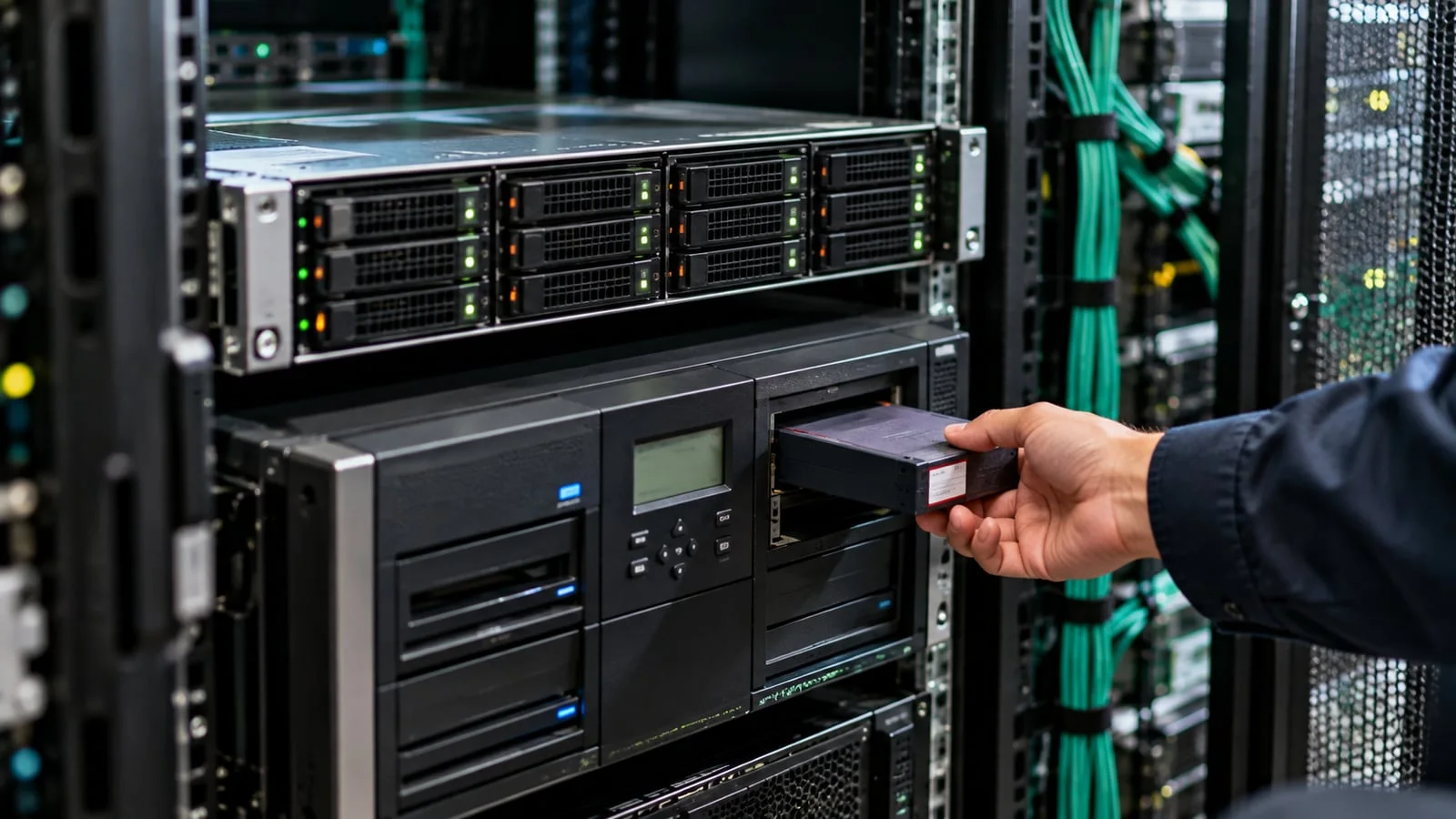
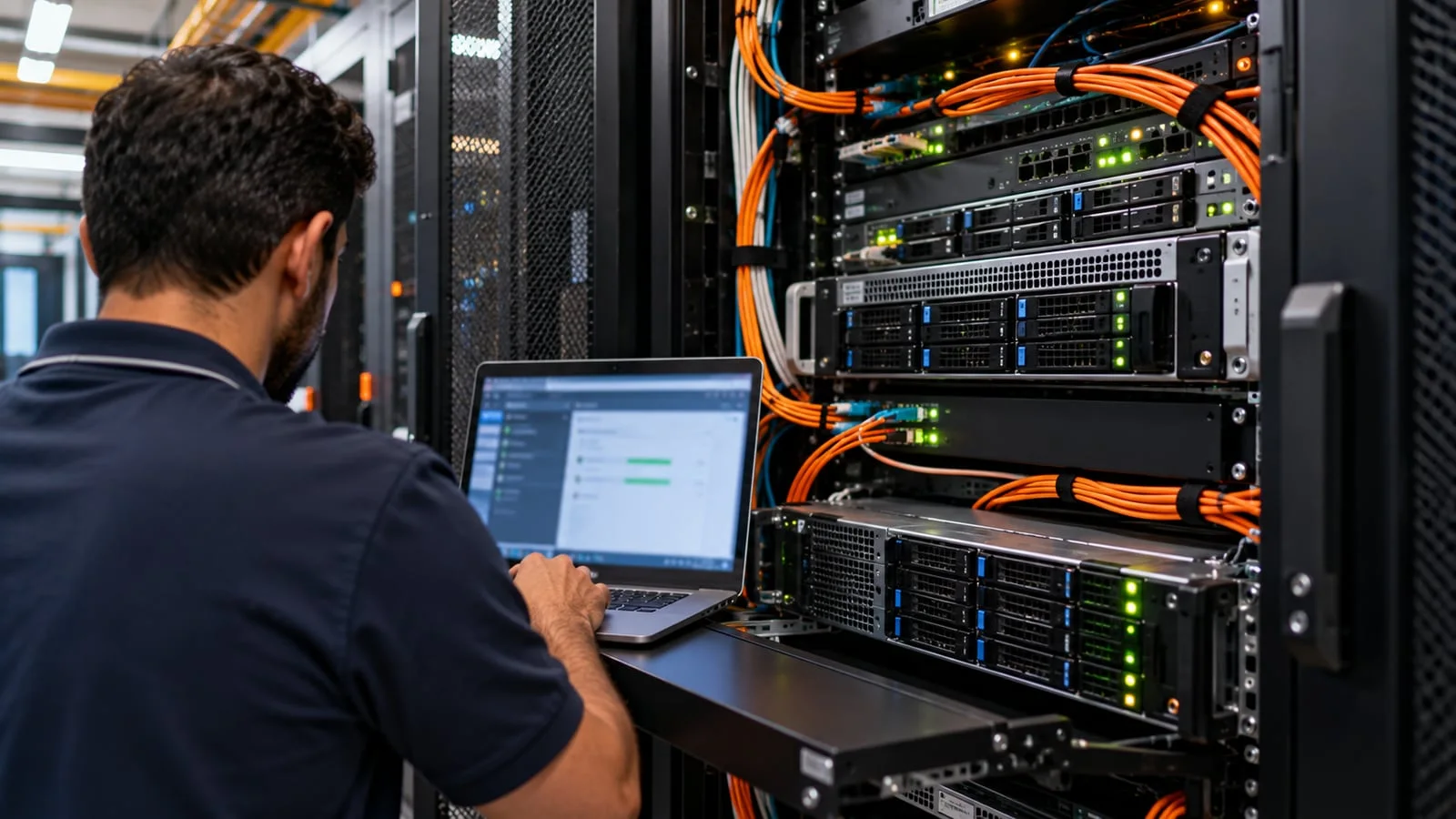
Hosting your servers or backups in a datacenter in Morocco starts with choosing a model: colocation if you want to keep your own servers in a professional power, cooling and network environment; cloud or managed hosting if you would rather rent resources without handling hardware; a second site (branch office, warehouse, another building) if the main goal is to move a backup copy away. Only then do you choose the datacenter, on verifiable criteria: announced versus certified Tier level, connectivity, power redundancy, physical access, SLA, reversibility and data location under law 09-08.
This guide is for business owners and IT managers of SMBs, in Casablanca and elsewhere in Morocco. It complements our guide to offsite backup, which covers protecting the data; here, the question is where to host it.
Why move servers out of your premises
An SMB server room often adds up weaknesses: an untested UPS, a domestic air conditioner, no suitable fire detection, a single internet line and a door anyone can open. The day of a long power cut, a summer overheat or a water leak, the business finds out it had no plan B.
A datacenter pools what an SMB cannot afford alone: generator-backed power, redundant cooling, access control, round-the-clock monitoring and a choice of network carriers. In return, you depend on a provider and on the link between your offices and the datacenter. And not everything has to move: a heavily used file server can stay on site, with a copy and a standby server in the datacenter.
Colocation, cloud or second site: three models
| Model | What you rent | What you manage | Suited to | Watch out for |
|---|---|---|---|---|
| Colocation | Rack space, power, cooling, connectivity | Your servers, their maintenance, OS and backups | Businesses that already own recent servers or a Proxmox or VMware platform | On-site work must be organised, hardware renewal is yours |
| Cloud or managed hosting | Virtual machines, storage, sometimes backup | Systems and applications, depending on the service level | Applications with no specific hardware, variable needs | Recurring costs to track, reversibility, hosting region |
| Company second site | Nothing: you use your own premises | Everything, including power and room security | Offsite backup copy, standby server | The second site often has the same weaknesses as the first |
The three can be combined. What matters is that a single incident cannot destroy production and every copy at once.
Criteria for choosing a datacenter in Morocco
Several operators offer datacenter and colocation services in Morocco. Rather than ranking them, we apply the same grid to every offer and ask for written evidence.
Tier classification: announced or certified?
The Uptime Institute Tier classification describes in four levels how redundant the power and cooling are. Tier III can be maintained without shutting down servers; Tier IV is designed to tolerate a failure. For an SMB, Tier III is generally a good level.
“Designed to Tier III standards” is not a certification. Ask whether the site is certified by the organisation, and for what: the design, the constructed facility or operations. A design-only certification says nothing about how the site is actually run.
Power and cooling
Ask how many power paths reach the rack, what fuel autonomy and refuelling arrangements the generators have, and how they are tested. For your servers, use dual power supplies on two separate circuits: a redundant datacenter is useless if your server has a single cable.
Connectivity and carrier neutrality
A “carrier-neutral” datacenter lets you choose between several network carriers present on site: you can compare offers, add a second carrier and switch provider without moving your servers. Also check the link between your offices and the datacenter (dedicated line, VPN over two links or SD-WAN): it determines user experience and restore times. Our advice on business fibre applies here.
Physical access and security
Who can enter, how is access logged and escorted, is the rack locked? Also ask about the “remote hands” service: can on-site staff restart a server or swap a disk on your request, and how fast?
SLA, support and penalties
Read what the contract actually guarantees: availability of power, cooling and network, response time, penalties. An SLA with no penalty and no measurement is an intention, not a commitment. Our article on managed IT contract clauses explains how to read an SLA.
Reversibility
In colocation, you take your servers back. In the cloud, leaving depends on export formats and data egress fees. Have the format, timing and assistance written into the contract.
Evaluation grid for a datacenter offer
| Criterion | Question to ask | Evidence to request |
|---|---|---|
| Tier | Certified by the organisation or only “designed to”? | Certificate and scope (design, construction, operations) |
| Power | How many power paths per rack, how are generators tested? | Simplified electrical diagram, recent test report |
| Connectivity | Which carriers are present, can another be added? | Carrier list, connection terms |
| Access | Who gets in, how it is logged, what hours? | Access procedure, access log on request |
| Remote hands | Which tasks, how fast? | Service catalogue and contractual times |
| SLA | What happens if the commitment is missed? | Contract with penalties and measurement method |
| Reversibility | How to leave, with which data and format? | Written reversibility clause |
| Location | Where are the data and copies physically? | Site address, cloud region, list of subcontractors |
Law 09-08 and data location
As soon as your servers or backups contain personal data, which is almost always, hosting falls under law 09-08. The datacenter or cloud provider becomes a processor, which must be bound by a contract setting out its security and confidentiality obligations. Hosting outside Morocco is a data transfer, subject to conditions that depend on the destination country.
Decide on location before the project (where servers are, where backups go, who can access them) and document it for your compliance file. The obligations are covered in our article on law 09-08 and the CNDP, and regulated sectors should have the design validated by their legal counsel.
A datacenter does not replace backup
The datacenter protects against a fire at your premises or a power cut, not against accidental deletion, ransomware or a compromised administrator account, which reach the server wherever it sits.
An immutable, encrypted backup copy, stored in a different location from production and out of reach of everyday accounts, remains essential. If production is in a datacenter, the copy must be elsewhere: at your premises, in a second datacenter or with a separate storage provider. Immutability options are compared in our article on the 3-2-1 rule and immutable backup, and how to check that a restore works in our restore testing method.
The method, step by step
- Inventory servers, applications and data, with their criticality.
- Set recovery needs (acceptable data loss and downtime) per application, with management.
- Choose the model per application: stay on site, colocation, cloud, or a mix.
- Evaluate offers with the grid above, backed by written evidence.
- Design the network between offices and datacenter.
- Place backups: fast local copy, immutable offsite copy, in a location separate from production.
- Migrate in stages, least critical first.
- Test a restore and a failover, then document the procedure.
The most common mistakes
- Choosing a datacenter on rack price alone, without looking at connectivity or the SLA.
- Installing single-power-supply servers in colocation.
- Keeping production and all backups in the same datacenter.
- Forgetting the office-to-datacenter link, which becomes the new single point of failure.
- Not knowing which country the backup copies are in.
Checklist before signing
- Model chosen application by application (on site, colocation, cloud).
- Tier level checked, certificate and scope in hand.
- At least two power paths to the rack, dual-power servers.
- Network carriers, physical access and remote hands known.
- SLA with penalties and measurement method.
- Written reversibility clause.
- Location of data and copies documented under law 09-08.
- Immutable copy in a location separate from production, tested.
How we do it
We start with an audit of your server room and applications, then you receive a hosting recommendation per application. We help you evaluate datacenter offers with the grid above, with no tie to any operator. We design the platform (Proxmox virtualisation and Veeam backup, as a Proxmox partner and Veeam partner), the inter-site network, then the migration. Servers and backups join our 24/7 monitoring, critical incidents are handled in under 15 minutes, and a control restore is scheduled regularly. Our case studies show comparable projects.
This service is part of our backup and business continuity offering, together with the disaster recovery plan that goes with it. The initial audit is free: contact us, we reply within 24 business hours.
Frequently asked questions
What is the difference between colocation and cloud hosting?
With colocation, you rent rack space, power and connectivity in a datacenter and install your own servers, which you manage. With cloud or managed hosting, you rent resources (virtual machines, storage) without owning or managing the hardware. Colocation gives more control, cloud gives more flexibility.
What does a datacenter's Tier classification mean?
The Tier classification, defined by the Uptime Institute, describes in four levels how redundant the power and cooling are. A Tier III site can be maintained without downtime, a Tier IV site is designed to tolerate a failure. Check whether the level is certified by the organisation, and what the certification covers, or merely claimed as "designed to".
Is hosting data outside Morocco allowed?
It is possible, but it is a data transfer under law 09-08 as soon as the servers or backups contain personal data. You need to check the conditions that apply to the destination country, bind the provider by contract and document the choice. Regulated sectors should have the design validated by their legal counsel.
Is a datacenter enough to protect my backups?
No. A datacenter protects against physical disasters at your premises, not against a mistake, ransomware or a compromised administrator account. You also need an immutable, encrypted copy, isolated from production accounts, and regular restore tests.
About the editorial team
ALLSAFE SOLUTIONS
Network, security and cloud engineers
Written by the engineering team at ALLSAFE SOLUTIONS, a managed IT provider founded in Casablanca by network, security and cloud engineers. Our articles draw on the projects we deliver for clients in Morocco and abroad.
LinkedIn