




































Patch rack and PoE switch: how to size an SMB’s network core
Network rack in Morocco: height in U, PoE budget for access points, IP phones and cameras, managed switches, VLANs and UPS. Our method for SMBs.

The day an SMB moves to IP telephony, adds WiFi access points or installs cameras, everything converges on the same place: the patch rack and the switch that powers those devices over the network cable. That is often where the project succeeds or fails, and often where it is underestimated. The short answer: start from an inventory of outlets and powered devices, calculate the total PoE budget before choosing the switch, use managed switches to separate traffic into VLANs, and plan a rack with free space and a UPS. Here is our method for sizing this network core in Morocco, the mistakes we fix most often and a checklist before ordering.
What a patch rack contains, and why it matters
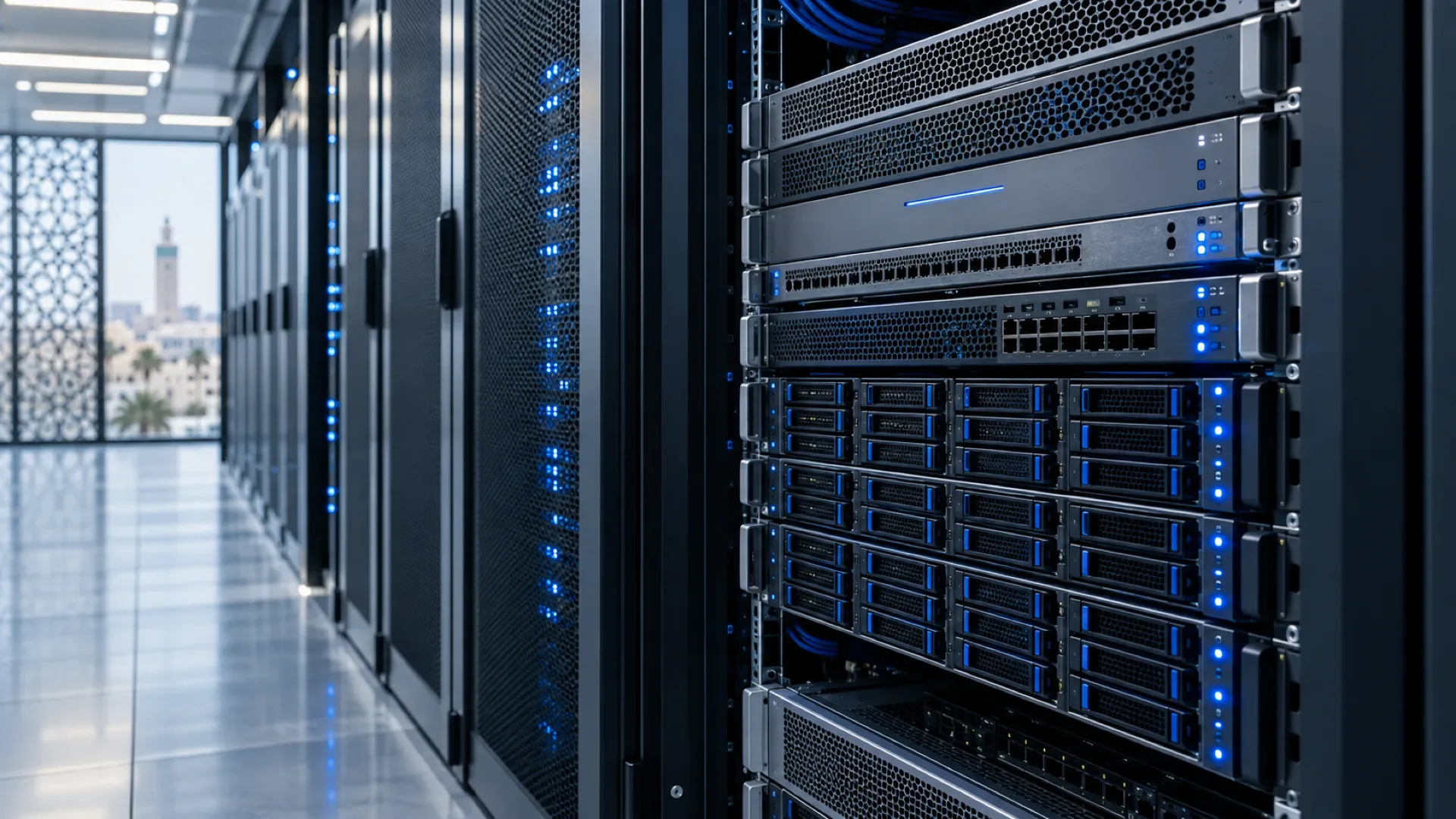
The patch rack is the cabinet where every cable in the building arrives, together with the active network equipment. It usually holds:
- patch panels, where the cables running to each wall outlet, access point and camera terminate;
- switches, connected to the panels with short patch cords;
- the firewall and the carrier’s equipment (router or fibre terminal);
- sometimes a server, a video recorder or the IP PBX;
- a UPS, cable managers, a power strip and ventilation.
A tidy rack is not about looks. When every cable is labelled and every port documented, a technician finds the outlet of a faulty desk in minutes. When everything is tangled, the smallest desk move takes half a day, and a cord pulled by mistake can bring down a whole service.
Step 1: inventory outlets and powered devices
First, we list everything that must be connected, today and over the next few years:
- fixed workstations and printers;
- IP phones, usually one per desk, plus reception and meeting room phones;
- WiFi access points, determined by the coverage study, see high-density enterprise WiFi;
- cameras, indoor and outdoor;
- other powered devices: access control, door intercoms, meeting room screens.
This gives two separate figures: the number of ports needed, and the list of devices that draw power from the switch. Both drive the choice of hardware.
Step 2: calculate the PoE budget
PoE, Power over Ethernet, powers a device through its network cable. It removes the need for a power socket next to each access point or camera, and lets you back everything up from the rack. But every switch has two limits: a maximum power per port, and a total PoE budget shared across all ports. The second figure is the one people forget.
| IEEE standard | Common name | Max. power per port (switch) | Power guaranteed at the device | Typical devices |
|---|---|---|---|---|
| 802.3af | PoE | 15.4 W | 12.95 W | IP phones, simple fixed cameras |
| 802.3at | PoE+ | 30 W | 25.5 W | WiFi access points, PTZ cameras, some phones with expansion modules |
| 802.3bt type 3 | PoE++ | 60 W | 51 W | High-end access points, small multiport devices |
| 802.3bt type 4 | PoE++ | 90 W | 71.3 W | Cameras with heaters, displays, power-hungry devices |
The method takes three moves. Read the maximum consumption and required standard on each device’s datasheet. Add them up. Compare with the switch’s total budget, keeping headroom for the access points or cameras you will add later.
A cautious calculation example, using the ceiling of each standard: 20 phones on 802.3af come to 308 W, 6 access points on PoE+ to 180 W, 8 cameras on 802.3af to 123.2 W. The total reaches 611.2 W. Real consumption is often lower, but the worst case is what counts: a switch whose budget is exceeded refuses to power the last devices, or drops them at startup, and the symptom looks like a random fault.
Also check generation compatibility: a recent access point that requires PoE+ may start in a degraded mode on an 802.3af port, with some of its radios disabled.
Step 3: managed or unmanaged switch
An unmanaged switch is plugged in and works, with no settings. A managed switch can be configured and monitored. For an SMB running telephony, WiFi and cameras, the latter is almost always required.
| Need | Unmanaged | Managed |
|---|---|---|
| Separate voice, data, cameras, guests (802.1Q VLANs) | No | Yes |
| Automatically place phones in the voice VLAN | No | Yes, depending on model (LLDP-MED, voice VLAN) |
| Prioritise voice over other traffic (QoS) | No | Yes |
| Remotely restart a frozen access point or camera (port PoE cycle) | No | Yes |
| Monitor ports, PoE consumption and errors | No | Yes |
| Link aggregation, redundancy to the firewall | No | Yes |
VLANs are the main reason. A single network where desktops, phones, cameras and visitors mix is both slower and more exposed: a compromised camera or a malicious guest sees everything else. Separating traffic and letting the firewall filter exchanges between segments is one of the first concrete steps of Zero Trust for SMBs.
FortiSwitch, UniFi and the rest
If your firewall is a FortiGate, FortiSwitch units are driven directly from its console through the FortiLink protocol: VLANs, PoE and network access control are configured in the same place as the security rules, and Fortinet states that many features, including access control, require no additional licence in this mode. It is the consistent choice for a site already equipped, see our Fortinet page and our guide FortiGate: which model to choose. We also install Ubiquiti UniFi switches, managed from the same console as the brand’s access points; the choice between the two ecosystems is covered in Ubiquiti UniFi or Fortinet FortiAP.
IP telephony, PoE’s first customer
The IP phones we deploy with 3CX, Yeastar or Grandstream are almost always PoE-powered. A voice VLAN, QoS priority and a backed-up switch make the difference between reliable telephony and choppy calls, as we explain in 10 mistakes that degrade call quality. To choose the phone system itself, see our guide to business IP phone systems in Morocco.
Step 4: size the rack
Rack height is counted in units, written U. To choose it, list every item that will go in with its height: patch panels, cable managers, switches, firewall, UPS, a shelf for the carrier’s equipment, possibly a server. Add them up, then leave free space: a rack that is full on day one prevents adding a switch and forces equipment to be crammed together, which hurts ventilation.
Three other criteria matter as much as height:
- depth, to check for a UPS or server, which are deeper than a switch;
- location: a ventilated, lockable room away from water, rather than a cupboard under the stairs;
- format: a wall-mounted cabinet for a small office, a floor-standing rack as soon as it must hold a rack-mount UPS or a server.
For cabling, category 6 covers common office needs; category 6A is worth considering if you plan recent access points with multigigabit uplinks. Certified cabling labelled at both ends saves hours of searching later.
Step 5: the UPS, without which nothing holds
With PoE, the rack powers phones, access points and cameras. A power cut that turns off the switch therefore cuts telephony, WiFi and video surveillance at the same moment. The UPS must cover the PoE switch, the firewall and the carrier’s equipment, taking into account the total PoE consumption calculated above, which weighs heavily in the load. Choose a manageable model, so you receive an alert during a power cut and can track the battery’s condition, which wears over time.
The mistakes we fix most often
- An exceeded PoE budget: the last cameras or access points switch off at random.
- Cascaded unmanaged switches, so no VLANs and no priority for voice.
- PoE injectors and power adapters scattered across offices, impossible to back up.
- A rack full on day one, with no room for an extra switch.
- No labelling: nobody knows which outlet maps to which port.
- A UPS that only covers the server, not the switch or firewall.
- A rack in a hot, unventilated room, shortening equipment life.
Checklist before ordering
- Inventory of outlets and powered devices, including planned additions.
- Maximum consumption and PoE standard of each device taken from its datasheet.
- Total switch PoE budget above the calculated sum, headroom included.
- Managed switches with VLANs, voice VLAN and QoS.
- VLAN plan defined: desktops, voice, cameras, staff WiFi, guests.
- Rack height, depth and location validated.
- Certified, labelled cabling and documented patch panels.
- UPS sized for the PoE switch, firewall and carrier equipment.
- Monitoring of switches and UPS planned.
How we do it
We start with a site survey: floor plans, existing outlets, technical room, devices to power and upcoming projects. We then produce the inventory, the PoE budget calculation, the VLAN plan and the rack layout, followed by a transparent hardware quote. During installation we patch, label and document every port, configure VLANs and voice priority, and add switches and UPS to our 24/7 monitoring: a port in error, a PoE budget near its limit or a power cut triggers an alert, and a critical incident is handled in under 15 minutes. Our case studies show comparable network projects.
This work is part of our network infrastructure and WiFi offering. Moving offices, switching to IP telephony or running out of rack space? Start with the free initial audit: contact us, we reply within 24 business hours.
Frequently asked questions
What is the difference between PoE, PoE+ and PoE++?
They are three generations of the IEEE standard: 802.3af (PoE, 15.4 W per port at the switch), 802.3at (PoE+, 30 W) and 802.3bt (PoE++, 60 W for type 3 and 90 W for type 4). The power actually available at the device is slightly lower because of cable losses.
How do you calculate a switch’s PoE budget?
List every powered device, read its maximum consumption on its datasheet, add everything up and compare it with the switch’s total PoE budget, which is different from the per-port maximum. Keep headroom for future additions.
Is an unmanaged switch enough for an SMB?
For a very small office without IP telephony or guest WiFi, sometimes. As soon as you need to separate voice, data, cameras and guests into VLANs, prioritise voice or monitor ports, a managed switch becomes necessary.
Should the PoE switch be on a UPS?
Yes: the PoE switch powers the phones, WiFi access points and cameras. If it shuts down during a power cut, all of those devices stop with it. The UPS should also cover the firewall and the carrier’s equipment.
About the editorial team
ALLSAFE SOLUTIONS
Network, security and cloud engineers
Written by the engineering team at ALLSAFE SOLUTIONS, a managed IT provider founded in Casablanca by network, security and cloud engineers. Our articles draw on the projects we deliver for clients in Morocco and abroad.
LinkedIn